

If you’re researching the latest developments in wearable tech hardware, you’re likely trying to separate real innovation from marketing hype. With new devices launching at a rapid pace, evolving sensor capabilities, and tighter integration with digital ecosystems, it’s harder than ever to know which advancements truly matter.
This article breaks down the most important trends shaping wearable tech hardware today—from emerging components and performance upgrades to infrastructure requirements and long-term viability. Whether you’re optimizing a setup, evaluating new devices, or tracking future-ready technology, you’ll find clear, focused insights designed to match your search for practical, up-to-date information.
Our analysis draws from documented tech protocols, hardware performance benchmarks, and current digital infrastructure developments to ensure accuracy and relevance. By the end, you’ll have a grounded understanding of where the technology stands now—and where it’s heading next.
Health trackers promise insight, but numbers alone can confuse. Heart rate variability, blood oxygen saturation, accelerometers—what does it mean? At its core, wearable tech hardware combines sensors, processors, and software to translate body signals into readable data. An accelerometer measures movement; a gyroscope tracks orientation; optical sensors use light to estimate pulse. Data becomes useful only when interpreted in context.
Consider:
- Steps without intensity tell little about fitness.
- Sleep scores need consistent routines to matter.
Some argue smartphones already do enough. True, but dedicated sensors capture continuous biometrics, offering clearer trends over time (think less guesswork, more evidence).
The Core Architecture: What Makes a Wearable “Smart”?
First, let’s move past the marketing buzzwords. A “smart” wearable isn’t magic—it’s a compact data collection system designed for the human body. In practical terms, these devices combine microprocessors (tiny computers on a chip), biometric sensors, and wireless connectivity to turn your daily movements into measurable insights. That means you’re not just wearing a gadget; you’re wearing a feedback loop that can improve workouts, sleep, and even stress management.
So how does it actually work? The process is surprisingly straightforward. Sensors collect raw biometric data—like heart rate, motion, or blood oxygen levels. Next, the processor interprets that data using embedded algorithms. Finally, the device displays insights or syncs them to an app. In other words, numbers become actionable information. (Yes, your wrist is basically running a mini lab.)
Under the hood, most wearable tech hardware shares four core components: a System on a Chip (SoC), which acts as the brain; a sensor array, which gathers inputs; a battery, powering everything; and a display or haptic engine, delivering feedback. The benefit? Real-time awareness. Instead of guessing about your health or performance, you gain data-backed clarity—and that’s a powerful upgrade.
A Guide to Form Factors: Choosing Your On-Body Companion
Choosing an on-body device isn’t just about features—it’s about form factor, or the physical design that determines how (and how often) you’ll actually wear it. While most comparisons obsess over specs, the real competitive edge lies in understanding how each format fits into daily life.
Smartwatches: The All-in-One Hub
Smartwatches act as wrist-based command centers, extending your phone with notifications, calls, and apps. More importantly, they integrate advanced health sensors like ECG (electrocardiogram, which measures heart rhythm irregularities) and blood oxygen monitoring. In other words, they’re multitaskers. Critics argue they’re overkill for casual users—and yes, battery life often suffers because of it. However, for professionals juggling messages, payments, and health metrics in one glance, that tradeoff makes sense. Think of it as the Swiss Army knife of wearable tech hardware (feature-packed, occasionally bulky).
Fitness Trackers & Bands: The Minimalist Data-Logger
By contrast, fitness bands strip things down. They prioritize step counts, heart rate trends, and sleep cycles—often lasting a week or more per charge. Some say they lack smart features, but that’s precisely their advantage: fewer distractions, cleaner data. For athletes or data purists, simplicity equals consistency.
Smart Rings & Patches: The Discreet Specialists
Meanwhile, smart rings like Oura and continuous glucose monitors (CGMs) focus on high-fidelity metrics with minimal intrusion. A CGM, for example, continuously measures glucose levels in interstitial fluid, offering insights critical for metabolic health. These devices sacrifice broad functionality for precision. That niche focus mirrors trends discussed in ai accelerators and the future of high performance computing—specialized tools outperform general-purpose ones in targeted tasks.
Ultimately, the best companion isn’t the most powerful. It’s the one you’ll actually wear.
Inside the Sensor Array: The Technology That Tracks You
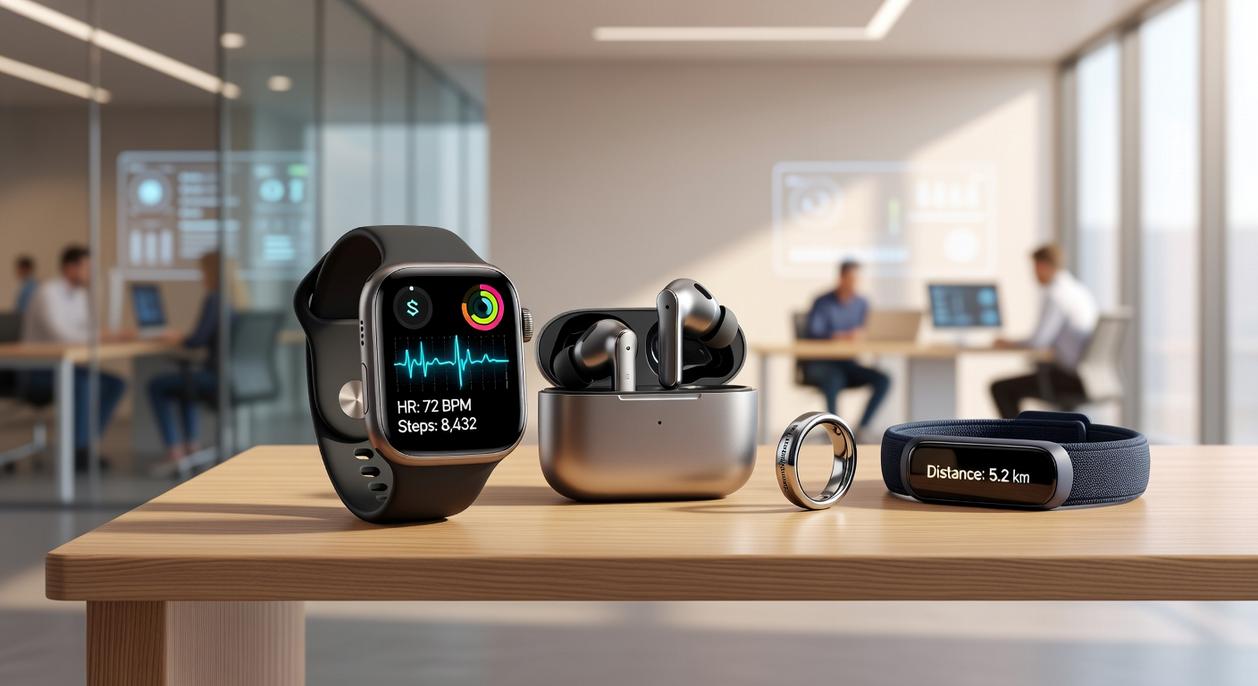
Have you ever wondered how your watch knows you’re stressed before you do? Or how it can tell the difference between a jog and a tennis swing? Let’s step inside the sensor array.
First up: Optical Heart Rate Sensors (PPG). Photoplethysmography (PPG) sounds intimidating, but it’s simple in practice. Tiny green LED lights shine into your skin and measure changes in blood flow. As your heart beats, blood volume shifts—those fluctuations are translated into heart rate data. From there, algorithms calculate heart rate variability (HRV)—the variation in time between beats—and even estimate blood oxygen (SpO2) by analyzing light absorption differences (NIH, 2022). Clever, right?
Next, motion tracking relies on:
- Accelerometers: Measure linear movement (steps, jumps, sleep tossing).
- Gyroscopes: Detect rotation and orientation (think swim strokes or golf swings).
Together, they map movement in 3D space. That’s how your device distinguishes walking from cycling—or a freestyle stroke from backstroke. Sound familiar when your step count mysteriously spikes during laundry duty?
Then there’s Bioelectrical Impedance Analysis (BIA). This tech sends a tiny, painless electrical current through your body to estimate body composition. Because fat and muscle conduct electricity differently, the device approximates body fat percentage and muscle mass. Is it lab-accurate? Not quite. But for trend tracking, it’s surprisingly useful (Mayo Clinic, 2023).
Finally, GPS and Location Services. Built-in GPS works independently—ideal for phone-free runs. Connected GPS, on the other hand, relies on your smartphone’s signal (battery-saving, but less autonomous). If you’re serious about training, which would you trust?
All of this lives inside modern wearable tech hardware—quietly collecting, calculating, and translating your daily life into data.
Integrating Your Data: From Raw Numbers to Actionable Insights
The device on your wrist? That’s just the sensor. The real magic happens inside the app. User interface (how information is visually organized), trend charts, and automated insights turn raw metrics into patterns you can actually use. Without that layer, wearable tech hardware is just a very expensive step counter.
Some people argue that “data is data” and you can interpret it yourself. In theory, sure. In practice, most of us won’t manually graph heart rate variability at 10 p.m. (be honest). The app does the heavy lifting.
Building a Personal Baseline
Before optimizing anything, establish a baseline—your normal range over time.
- Track resting heart rate daily for 3–4 weeks.
- Log sleep duration and quality consistently.
- Note external factors: stress, travel, late meals.
Baseline means your typical average under normal conditions. For example, if your resting heart rate averages 62 bpm for a month, a sudden jump to 70 may signal stress or illness (Harvard Health, 2023).
Pro tip: Don’t react to one bad night. Look for trends over 7–14 days.
Connecting to a Wider Ecosystem
Sync data with platforms like Apple Health or Google Fit to centralize activity, nutrition, and mindfulness stats. This creates a holistic dashboard—your digital health command center. The clearer the system, the smarter your decisions.
Stay Ahead in the Tech Evolution
You came here to understand where innovation is heading and how emerging systems, archived protocols, and wearable tech hardware are shaping the next wave of digital infrastructure. Now you have a clearer picture of the trends driving change—and how they directly impact your ability to build, adapt, and stay competitive.
The reality is simple: technology moves fast, and falling behind means missed opportunities, outdated systems, and costly upgrades. Staying informed isn’t just helpful—it’s essential if you want reliable performance, future-ready setups, and smarter integration decisions.
Act now. Subscribe for real-time innovation alerts, explore our latest tech setup tutorials, and tap into the insights trusted by thousands of forward-thinking builders and digital enthusiasts. If you’re serious about keeping your systems optimized and future-proof, start today and stay ahead of what’s next.
 Heathers Gillonuevo writes the kind of archived tech protocols content that people actually send to each other. Not because it's flashy or controversial, but because it's the sort of thing where you read it and immediately think of three people who need to see it. Heathers has a talent for identifying the questions that a lot of people have but haven't quite figured out how to articulate yet — and then answering them properly.
They covers a lot of ground: Archived Tech Protocols, Knowledge Vault, Emerging Hardware Trends, and plenty of adjacent territory that doesn't always get treated with the same seriousness. The consistency across all of it is a certain kind of respect for the reader. Heathers doesn't assume people are stupid, and they doesn't assume they know everything either. They writes for someone who is genuinely trying to figure something out — because that's usually who's actually reading. That assumption shapes everything from how they structures an explanation to how much background they includes before getting to the point.
Beyond the practical stuff, there's something in Heathers's writing that reflects a real investment in the subject — not performed enthusiasm, but the kind of sustained interest that produces insight over time. They has been paying attention to archived tech protocols long enough that they notices things a more casual observer would miss. That depth shows up in the work in ways that are hard to fake.
Heathers Gillonuevo writes the kind of archived tech protocols content that people actually send to each other. Not because it's flashy or controversial, but because it's the sort of thing where you read it and immediately think of three people who need to see it. Heathers has a talent for identifying the questions that a lot of people have but haven't quite figured out how to articulate yet — and then answering them properly.
They covers a lot of ground: Archived Tech Protocols, Knowledge Vault, Emerging Hardware Trends, and plenty of adjacent territory that doesn't always get treated with the same seriousness. The consistency across all of it is a certain kind of respect for the reader. Heathers doesn't assume people are stupid, and they doesn't assume they know everything either. They writes for someone who is genuinely trying to figure something out — because that's usually who's actually reading. That assumption shapes everything from how they structures an explanation to how much background they includes before getting to the point.
Beyond the practical stuff, there's something in Heathers's writing that reflects a real investment in the subject — not performed enthusiasm, but the kind of sustained interest that produces insight over time. They has been paying attention to archived tech protocols long enough that they notices things a more casual observer would miss. That depth shows up in the work in ways that are hard to fake.