

If you’re searching for a clear, practical version control systems comparison, you likely want more than a surface-level feature list. You want to understand which system fits your workflow, scales with your infrastructure, and supports modern development demands without unnecessary complexity.
This article breaks down the most widely used version control systems, highlighting their core architectures, collaboration models, performance trade-offs, and integration capabilities. Whether you’re managing solo projects, distributed teams, or enterprise-grade repositories, we focus on the factors that directly impact speed, reliability, and long-term maintainability.
Our analysis draws on real-world implementation patterns, documented performance benchmarks, and current development ecosystem standards. Instead of repeating marketing claims, we examine how these systems behave in production environments and evolving DevOps pipelines.
By the end, you’ll have a clear understanding of the strengths, limitations, and ideal use cases for each option—so you can choose the version control solution that aligns with your technical goals and infrastructure strategy.
Choosing Your Source Code’s Guardian: A Modern VCS Comparison
Picking a VCS isn’t academic; in fast-moving fintech teams in New York or game studios optimizing Unreal builds in Montreal, it shapes daily velocity. This version control systems comparison cuts through hype.
- Git: Distributed architecture (every clone is a full repository) boosts resilience and branching flexibility.
- SVN: Centralized model simplifies access control for regulated industries.
- Mercurial: Cleaner CLI, strong for mid-sized teams.
- Perforce: Handles massive binary assets common in AAA pipelines.
Some argue Git fits all. Yet media files can choke it without LFS. Match tooling to workflow and scale.
The Foundational Split: Centralized vs. Distributed Models
To begin with, a Centralized Version Control System (CVCS) uses a single server—think of a hub-and-spoke model popularized by Subversion in the early 2000s. Developers commit code to one central repository. The upside? It’s straightforward to learn and offers granular access control, meaning admins can tightly manage who edits what. However, there’s a catch: it creates a single point of failure. If the server goes down (or the network hiccups), work stalls.
In contrast, a Distributed Version Control System (DVCS), like Git—widely adopted after 2005—gives every developer a full copy of the repository. This peer-to-peer model enables offline work, faster operations, and superior branching and merging. Still, beginners often find the learning curve steeper (Git can feel like learning chess after checkers).
Ultimately, this version control systems comparison shapes workflow, collaboration style, and infrastructure decisions for years.
Deep Dive: Git – The De Facto Standard for Collaboration
Open a terminal, type git status, and there it is—the crisp, immediate response blinking back at you. Git feels fast because it is fast. Unlike older centralized systems, most operations happen locally, meaning commits, diffs, and logs execute almost instantly (no waiting on a distant server to clear its throat).
At the heart of Git is the staging area—a preparatory space where you selectively bundle changes before committing. Think of it as laying out puzzle pieces on a table before snapping them into place. This extra step gives developers surgical precision, especially during complex feature updates.
Then there’s cheap local branching. In Git, branches are lightweight pointers, not bulky copies. You can spin up a new feature branch in seconds, experiment freely, and merge it back without friction. This fuels non-linear development—multiple ideas evolving simultaneously like parallel storylines in a sci‑fi epic.
Naturally, Git shines in open-source projects, large distributed teams, and agile environments where frequent branching and merging are the norm. However, critics argue its command set can feel cryptic to newcomers—and they’re not wrong. Commands like rebase or cherry-pick can sound intimidating at first. Additionally, Git historically struggled with very large binary files or monolithic repositories, though tools like Git LFS have improved that landscape.
In any version control systems comparison, Git’s ecosystem stands out. GitHub, GitLab, and Bitbucket provide seamless collaboration, while nearly every IDE integrates Git natively. As a result, whether you’re coding solo at midnight or merging pull requests with a global team, Git remains the quiet engine humming beneath modern software development.
Deep Dive: Subversion (SVN) – The Power of Simplicity
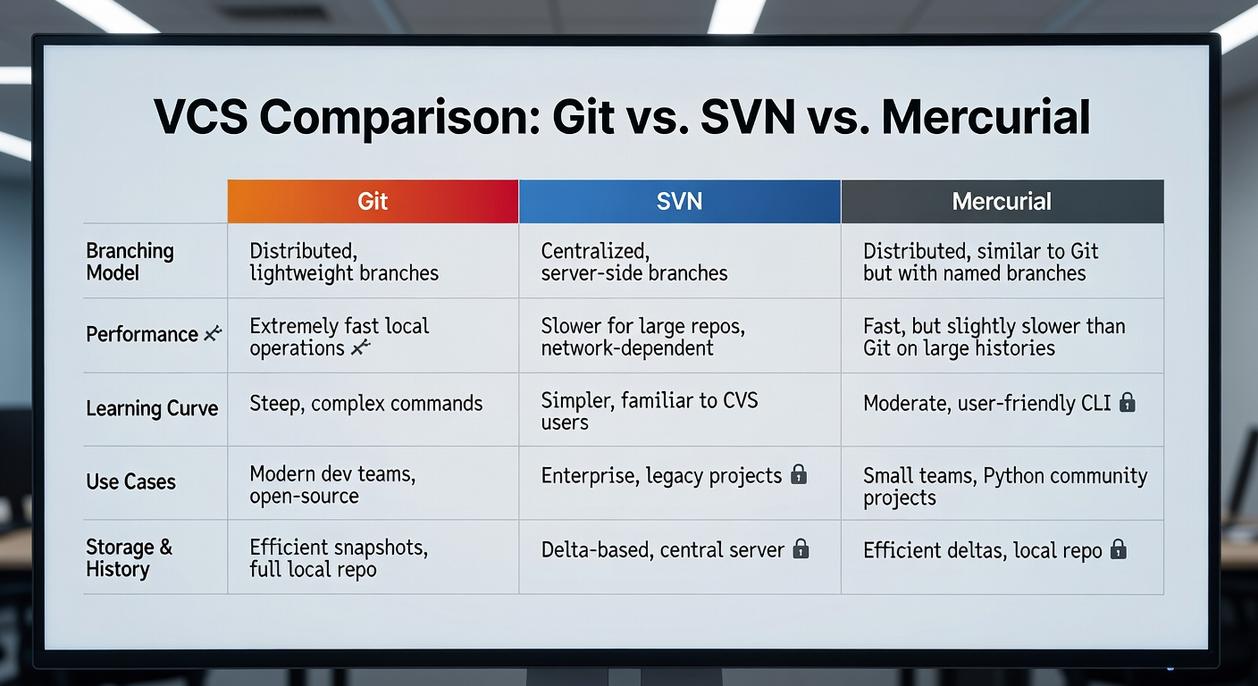
Subversion (SVN) is often described as “boring.” In infrastructure, that’s a compliment. Its intuitive command structure—checkout, update, commit—mirrors plain English, reducing onboarding friction for new teams. SVN also uses atomic commits, meaning changes either succeed entirely or fail completely (no half-applied updates). For regulated environments, that reliability isn’t flashy—it’s essential.
Unlike distributed systems, SVN maintains a straightforward, linear history. Every revision increments globally, making audits and compliance reviews simpler. In a version control systems comparison, this centralized model trades flexibility for clarity. That’s a feature when traceability matters.
SVN also handles large binary files and versioned directories natively. Design assets, CAD files, and documentation repositories don’t require extra extensions. Teams managing non-code assets benefit immediately.
Ideal use cases include corporate environments with strict access controls, linear workflows, and teams new to version control. Fine-grained permissions at the directory level make governance practical, not theoretical.
Critics argue SVN is slower because most operations require network access—and branching and merging are less elegant than Git. Fair point. But in controlled ecosystems, simplicity reduces costly mistakes.
For foundational terms, see a comprehensive glossary of essential technology terms.
Sometimes, the most competitive advantage is fewer moving parts.
Beyond the Big Two: Mercurial and Perforce Helix Core
When engineers debate alternatives, the conversation often sounds like this: “Git is powerful,” one says. “Sure,” another replies, “but I just want something that makes sense.” That’s where Mercurial (Hg) enters. As a distributed version control system (DVCS)—meaning every developer has a full copy of the repository—Mercurial emphasizes simplicity. Its clean command structure reduces cognitive load (no need to memorize cryptic flags), though its community is smaller than Git’s. In many version control systems comparison discussions, developers praise Hg for being INTUITIVE.
Then there’s Perforce Helix Core—a different beast entirely.
- Centralized server
- Distributed workflow flexibility
- Massive binary asset handling
“We push terabytes daily,” a game studio lead once noted. Helix Core dominates industries managing huge binary files—video games, semiconductor layouts, emerging hardware simulations—where performance at scale isn’t optional. It’s mission-critical. In those environments, speed isn’t nice-to-have. It’s EVERYTHING.
A Decision-Making Framework for Your Next Project
You’ve seen the options; now it’s time to choose the right tool to build your project’s digital foundation. Think of this as your practical version control systems comparison moment—less theory, more clarity.
Start with the core questions:
- Team Size & Location: Solo builder, co-located crew, or globally distributed team?
- Project Type: Mostly text-based code, or heavy binary assets like game art and video?
- Workflow Needs: Complex, non-linear branching (multiple parallel development paths) or a simple, sequential history?
- Team Expertise: Are developers fluent in distributed systems, or do they need something straightforward?
Some argue Git is always the answer. They’re not wrong—its flexibility and ecosystem are unmatched. But that power can overwhelm smaller teams (like handing the Millennium Falcon to a first-time pilot).
Prediction (speculative): As remote work expands, distributed systems like Git will dominate even more.
Still, choose Git for most new projects. Opt for SVN or Perforce when simplicity or massive binary handling truly matter.
Take Control of Your Tech Stack Today
You came here looking for clarity on evolving digital infrastructure, smarter hardware adoption, and how to stay ahead of emerging tech protocols. Now you have a clearer roadmap to navigate innovation without second‑guessing every decision.
The real challenge isn’t access to information — it’s keeping up before your systems become outdated, inefficient, or vulnerable. Falling behind on infrastructure updates or ignoring early innovation signals can cost time, performance, and long‑term scalability.
That’s why staying proactive matters. Apply what you’ve learned. Review your current setup. Reassess your workflows. Run a version control systems comparison to ensure your development pipeline is optimized. Monitor hardware shifts before they become industry standards. Archive and document your protocols so nothing critical gets lost.
If tech sprawl, outdated configurations, or missed innovation cycles are slowing you down, now is the time to fix it. Thousands of forward‑thinking builders rely on trusted innovation alerts and infrastructure insights to stay competitive.
Don’t wait for failure to expose weaknesses. Upgrade your systems, refine your stack, and implement smarter tech strategies today. The next competitive edge belongs to those who act first.
 There is a specific skill involved in explaining something clearly — one that is completely separate from actually knowing the subject. Jelvith Rothwyn has both. They has spent years working with digital infrastructure insights in a hands-on capacity, and an equal amount of time figuring out how to translate that experience into writing that people with different backgrounds can actually absorb and use.
Jelvith tends to approach complex subjects — Digital Infrastructure Insights, Tech Setup Tutorials, Knowledge Vault being good examples — by starting with what the reader already knows, then building outward from there rather than dropping them in the deep end. It sounds like a small thing. In practice it makes a significant difference in whether someone finishes the article or abandons it halfway through. They is also good at knowing when to stop — a surprisingly underrated skill. Some writers bury useful information under so many caveats and qualifications that the point disappears. Jelvith knows where the point is and gets there without too many detours.
The practical effect of all this is that people who read Jelvith's work tend to come away actually capable of doing something with it. Not just vaguely informed — actually capable. For a writer working in digital infrastructure insights, that is probably the best possible outcome, and it's the standard Jelvith holds they's own work to.
There is a specific skill involved in explaining something clearly — one that is completely separate from actually knowing the subject. Jelvith Rothwyn has both. They has spent years working with digital infrastructure insights in a hands-on capacity, and an equal amount of time figuring out how to translate that experience into writing that people with different backgrounds can actually absorb and use.
Jelvith tends to approach complex subjects — Digital Infrastructure Insights, Tech Setup Tutorials, Knowledge Vault being good examples — by starting with what the reader already knows, then building outward from there rather than dropping them in the deep end. It sounds like a small thing. In practice it makes a significant difference in whether someone finishes the article or abandons it halfway through. They is also good at knowing when to stop — a surprisingly underrated skill. Some writers bury useful information under so many caveats and qualifications that the point disappears. Jelvith knows where the point is and gets there without too many detours.
The practical effect of all this is that people who read Jelvith's work tend to come away actually capable of doing something with it. Not just vaguely informed — actually capable. For a writer working in digital infrastructure insights, that is probably the best possible outcome, and it's the standard Jelvith holds they's own work to.