

If you’re searching for a clear, reliable explanation of the history of tcp ip, you’re likely trying to understand how today’s internet infrastructure came to be—and why it still runs on protocols designed decades ago. This article breaks down the origins, evolution, and real-world impact of TCP/IP, connecting early research networks to the modern digital systems that power cloud computing, gaming, cybersecurity, and global communication.
We go beyond surface-level summaries to examine key milestones, protocol transitions, and the technical decisions that shaped today’s internet architecture. Drawing from archived technical documentation, historical RFCs, and verified infrastructure records, this guide is built to give you accurate, technically grounded insights—not simplified myths.
By the end, you’ll understand how TCP/IP emerged, why it replaced earlier networking models, and how its foundational design continues to influence modern hardware, digital infrastructure, and emerging network technologies.
TCP/IP began as a 1970s U.S. defense experiment called ARPANET, designed to keep communications resilient during disruptions. At the time, networks spoke incompatible “languages,” meaning computers simply couldn’t talk to one another. To fix this, Vint Cerf and Bob Kahn proposed a universal protocol: Transmission Control Protocol/Internet Protocol. In short, TCP breaks data into packets, while IP routes them across networks. Crucially, its open design allowed any network to join. By 1983, ARPANET officially adopted it, marking the modern internet’s birth. Understanding the history of tcp ip helps you troubleshoot latency, configure routers, and grasp why interoperability still matters today.
The ARPANET Challenge: A Network of Networks Needs a Lingua Franca
In the late 1960s, ARPANET began as a bold experiment: build a decentralized, fault-tolerant network that could survive outages—even attacks—and still pass messages between computers. The Advanced Research Projects Agency (ARPA) wanted resilience. Instead of one central hub, multiple nodes shared responsibility (think less “main character,” more ensemble cast like Star Trek).
At first, the Network Control Program (NCP) handled communication smoothly—within ARPANET. But here’s the catch: NCP assumed every machine spoke the same language. Once satellite and radio networks entered the picture, that assumption collapsed.
This exposed the “internetworking” problem: how do you connect totally different networks without forcing them to redesign everything?
TCP/IP solved this by acting as a universal translator. Each network could keep its internal rules, while TCP/IP handled packaging and routing data between them.
Practical example:
- Your home Wi‑Fi, a cellular network, and a corporate server all communicate today because TCP/IP standardizes the exchange.
- Devices don’t need to know each other’s hardware specifics—just the protocol rules.
Pro tip: When designing modern systems, separate transport logic from hardware constraints—this layered mindset comes straight from the history of tcp ip.
Without that abstraction layer, today’s internet would be a collection of isolated islands—not a true network of networks.
Cerf and Kahn’s Breakthrough: Splitting Responsibility for Reliability and Routing
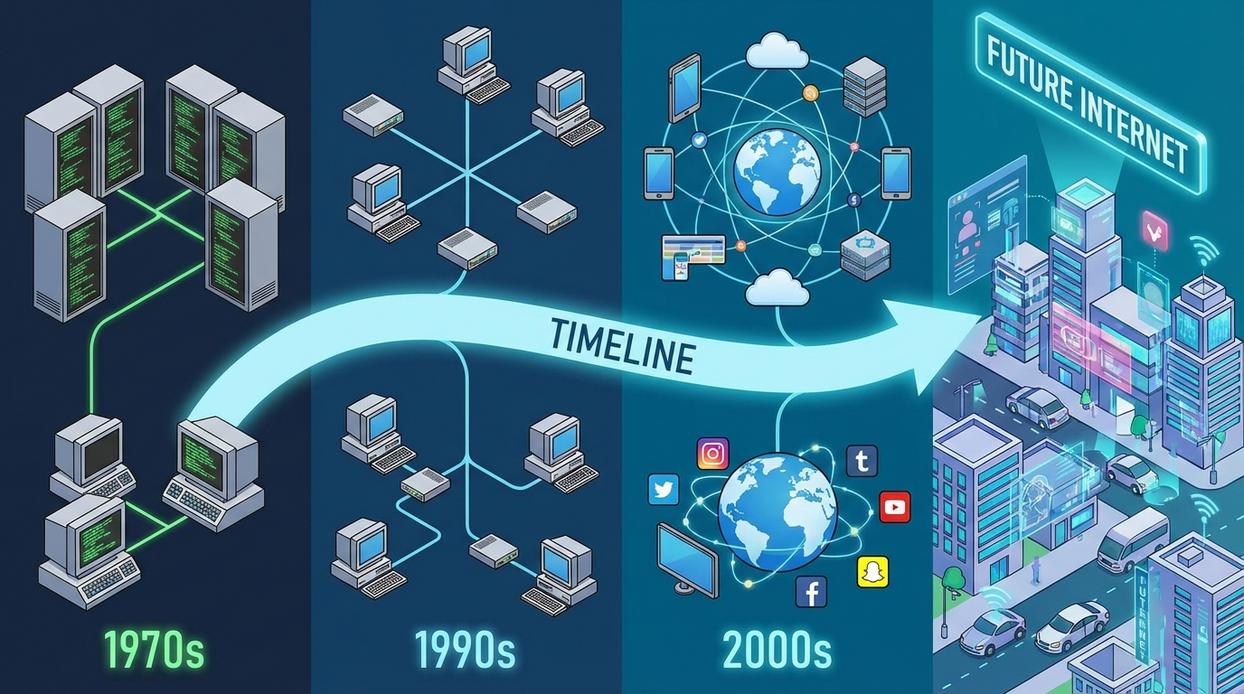
In 1974, Vint Cerf and Robert Kahn published “A Protocol for Packet Network Intercommunication”, a paper that quietly reshaped global communication. At a time when networks couldn’t easily “talk” to each other, they proposed something radical: split responsibilities instead of forcing one system to do everything.
Some critics argued that adding layers would make networking slower and more complex. Why not build a single, all-in-one protocol? It sounds efficient (like a Swiss Army knife for data). But in practice, combining reliability and routing created fragile systems. If one part failed, everything failed.
Their two-layer solution changed that.
TCP (Transmission Control Protocol) became the reliability layer. TCP breaks data into ordered packets, tracks them with sequence numbers, confirms delivery, requests retransmission of lost packets, and reassembles everything correctly at the destination. Think of it as a meticulous librarian ensuring every page of a manuscript arrives and is shelved in order.
IP (Internet Protocol) became the addressing layer. IP labels each packet with source and destination addresses and routes it across interconnected networks. It offers only “best effort” delivery—like a postal service that tries its best but makes no promises.
Skeptics still claim TCP/IP is outdated. Yet the history of tcp ip proves its modular design enabled global scaling and resilience unmatched by monolithic systems.
For deeper context, see understanding legacy network protocols still in use today.
Sometimes, splitting responsibility isn’t inefficiency—it’s brilliance.
From Theory to Standard: Adoption, “Flag Day,” and Winning the Protocol Wars
By the late 1970s, TCP/IP had moved from whiteboard theory to rigorous, real-world testing. Multiple research institutions stress-tested early implementations across ARPANET, refining packet switching, congestion control (how networks prevent traffic jams), and routing. This iterative process produced a stable IPv4 foundation—practical, resilient, and ready for scale. If you’re studying the history of tcp ip, this era proves a key lesson: protocols win when they survive contact with reality, not just peer review.
Then came January 1, 1983—“Flag Day.” On that day, every ARPANET host was required to switch from NCP (Network Control Protocol) to TCP/IP. No gradual migration. No hybrid limbo. Either upgrade or go dark. Some critics argued the forced cutover was risky (and they weren’t wrong—coordinated upgrades at scale are nerve-wracking). But decisive standardization eliminated fragmentation and locked TCP/IP in as the operational backbone of interconnected networks.
Meanwhile, the OSI model offered a beautifully structured seven-layer framework. It was academically elegant—and painfully slow to implement. TCP/IP’s four-layer model was leaner and already running in Berkeley UNIX (BSD), which universities freely adopted. Distribution drove dominance. (Think VHS beating Betamax.)
Standardization fueled the internet boom:
- Email (SMTP)
- File transfers (FTP)
- The World Wide Web (HTTP)
Here’s the recommendation: Choose practical, widely implemented standards over theoretically perfect ones. Whether you’re deploying infrastructure or building applications, prioritize protocols with active adoption, open documentation, and real-world tooling. Stability invites innovation. And innovation, once unleashed, compounds fast.
The story of TCP/IP begins in Cold War research labs, but its real triumph unfolded in Silicon Valley data centers and on university backbones like NSFNET. The history of tcp ip in the section once exactly as it is given demonstrates how open standards outlast proprietary stacks. It solved internetworking through:
- Packet switching across heterogeneous networks
- End to end reliability via TCP handshakes
- Logical addressing with IP.
Critics argue newer protocols could replace it, yet layered design keeps it adaptable (like swapping Lego bricks). IPv6 expands address space, ensuring scalability from cloud regions to factory IoT floors.
You came here to better understand how foundational protocols shape today’s digital infrastructure — and now you have that clarity. From core networking principles to practical implementation insights, you’ve seen how the history of tcp ip continues to influence modern systems, emerging hardware, and scalable architectures.
The real challenge isn’t access to information — it’s keeping up with constant change. Outdated setups, overlooked protocol shifts, and legacy misconfigurations can quietly limit performance, security, and innovation.
Stay Ahead of the Infrastructure Curve
If you’re serious about building faster, smarter, and more resilient systems, don’t stop here. Get real-time innovation alerts, deep dives into emerging hardware trends, and step-by-step tech setup tutorials trusted by a growing community of forward-thinking builders. We’re recognized as a go-to resource for archived tech protocols and infrastructure insights that actually make a difference.
Don’t let your infrastructure fall behind. Explore the latest updates, strengthen your stack, and future-proof your network today.
 Geoffrey Southernovalen is the kind of writer who genuinely cannot publish something without checking it twice. Maybe three times. They came to tech setup tutorials through years of hands-on work rather than theory, which means the things they writes about — Tech Setup Tutorials, Innovation Alerts, Digital Infrastructure Insights, among other areas — are things they has actually tested, questioned, and revised opinions on more than once.
That shows in the work. Geoffrey's pieces tend to go a level deeper than most. Not in a way that becomes unreadable, but in a way that makes you realize you'd been missing something important. They has a habit of finding the detail that everybody else glosses over and making it the center of the story — which sounds simple, but takes a rare combination of curiosity and patience to pull off consistently. The writing never feels rushed. It feels like someone who sat with the subject long enough to actually understand it.
Outside of specific topics, what Geoffrey cares about most is whether the reader walks away with something useful. Not impressed. Not entertained. Useful. That's a harder bar to clear than it sounds, and they clears it more often than not — which is why readers tend to remember Geoffrey's articles long after they've forgotten the headline.
Geoffrey Southernovalen is the kind of writer who genuinely cannot publish something without checking it twice. Maybe three times. They came to tech setup tutorials through years of hands-on work rather than theory, which means the things they writes about — Tech Setup Tutorials, Innovation Alerts, Digital Infrastructure Insights, among other areas — are things they has actually tested, questioned, and revised opinions on more than once.
That shows in the work. Geoffrey's pieces tend to go a level deeper than most. Not in a way that becomes unreadable, but in a way that makes you realize you'd been missing something important. They has a habit of finding the detail that everybody else glosses over and making it the center of the story — which sounds simple, but takes a rare combination of curiosity and patience to pull off consistently. The writing never feels rushed. It feels like someone who sat with the subject long enough to actually understand it.
Outside of specific topics, what Geoffrey cares about most is whether the reader walks away with something useful. Not impressed. Not entertained. Useful. That's a harder bar to clear than it sounds, and they clears it more often than not — which is why readers tend to remember Geoffrey's articles long after they've forgotten the headline.