

The promise of 5G was never just about faster downloads; it was about building a new digital foundation. Yet for many users, the experience still feels incremental rather than revolutionary. This guide closes that gap by unpacking the advanced components powering true 5g digital infrastructure—from dense small-cell deployments to network slicing and edge computing. Instead of repeating marketing claims, we break down the hardware, protocols, and architectural shifts that enable ultra-low latency, massive IoT ecosystems, and seamless cloud applications. By the end, you’ll understand what’s really driving next-generation connectivity—and why it matters for the future of a hyper-connected world.
Beyond the Tower: Deconstructing the New 5G Architecture
The era of the lone macro tower dominating the skyline is fading. In its place comes network densification—a design strategy that replaces a few powerful towers with a dense web of smaller, closer “small cells.” These compact base stations shorten the distance between users and antennas, which improves signal strength, boosts capacity, and reduces dropped connections in crowded urban corridors. Think of it like adding more checkout lanes at a busy store (no one enjoys waiting in a digital line).
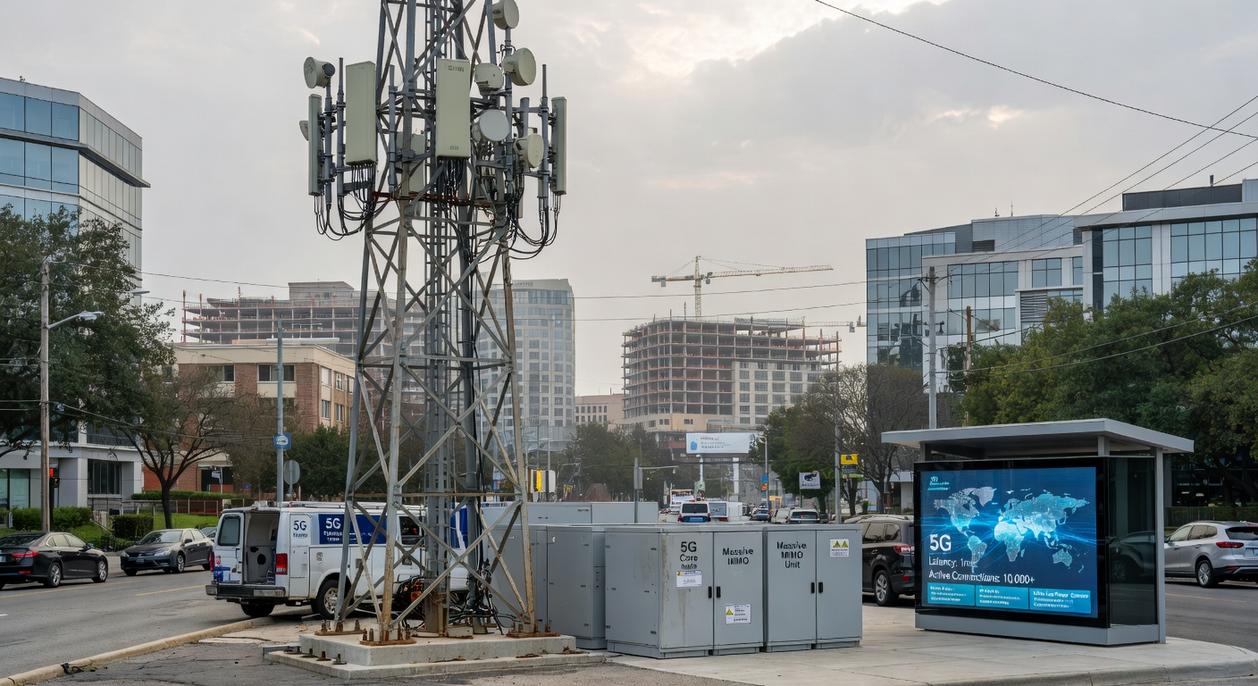
But densification is only step one. Enter Massive MIMO (Multiple Input, Multiple Output)—an antenna technology that equips base stations with dozens, sometimes hundreds, of antenna elements. Traditional systems might talk to a handful of devices at once. Massive MIMO allows simultaneous communication with many more users without slowing down. The benefit? Higher throughput in packed stadiums, transit hubs, and city centers.
Working alongside it is beamforming, often described as a “signal spotlight.” Instead of broadcasting radio waves in all directions, beamforming precisely directs the signal toward a specific device. This reduces interference, increases efficiency, and extends usable coverage—like adjusting a flashlight beam instead of lighting up the entire room.
Spectrum strategy ties it all together. Low-band frequencies travel far but offer modest speeds. Mid-band balances coverage and performance. High-band (mmWave) delivers ultra-fast speeds over short distances. A multi-band approach ensures comprehensive 5g digital infrastructure that blends reach with raw speed. The result is not just faster phones, but smarter, more resilient connectivity everywhere.
Customizing the Network: How Slicing Creates Dedicated Digital Lanes
Network slicing sounds technical, but the idea is simple. It means dividing one physical 5G network into multiple virtual networks, each tailored for a specific job. Think of it as turning one big road into several PRIVATE LANES, where each lane serves a different type of traffic.
On a public highway, you might imagine:
- One lane reserved for ambulances and emergency vehicles
- One optimized for heavy trucks
- One for everyday commuters
They all share the same road, but their rules and priorities differ. That’s network slicing.
In 5g digital infrastructure, this allows operators to create slices with specific performance traits. For example, a smart factory can run robotic arms on an ultra-reliable, low-latency slice. Low latency means near-instant response time—measured in milliseconds—so machines react without delay. Even if the public network is congested (say, during a big event), the factory’s slice stays unaffected.
Another example: a packed sports stadium. Thousands of fans streaming HD replays at once would normally choke a network. With a high-bandwidth slice—bandwidth meaning data capacity—video streams flow smoothly, no buffering wheel in sight (because no one likes that spinning circle of doom).
In short, one network. Multiple purposes. Zero compromise.
Eliminating Delay: The Critical Role of Edge Computing
A few years ago, I tested a cloud gaming demo at a tech expo. On paper, it promised console-level graphics streamed instantly. In reality? There was a split-second lag between pressing jump and seeing my character move (and yes, I missed the jump). That tiny delay is called latency—the time it takes for data to travel from your device to a server and back.
This is exactly the problem Multi-access Edge Computing (MEC) solves. Think of MEC as placing small data centers at the edge of the network, often right at the base of a cell tower. Instead of sending data to a distant cloud hundreds of miles away, it’s processed locally. The result is dramatically reduced round-trip time.
Some argue centralized cloud systems are already fast enough. For email or video streaming, that’s true. However, ultra-low latency becomes critical for real-time augmented reality overlays, responsive cloud gaming, and vehicle-to-everything (V2X) communication in autonomous cars. When milliseconds matter, “fast enough” isn’t enough.
By embedding compute power into 5g digital infrastructure, MEC enhances connectivity where it counts—at the user level. Of course, pushing computing outward also raises new security questions, which is why understanding cybersecurity frameworks every it team should know is increasingly essential.
From Theory to Reality: Where Advanced Infrastructure is Making an Impact
Smart Cities
Small cells (compact, low-power cellular nodes) combined with edge computing (processing data near the source instead of a distant cloud) power real-time traffic rerouting, adaptive street lighting, and AI-driven public safety monitoring. Thousands of IoT sensors feed data into localized hubs, cutting latency and easing congestion (think less gridlock, more flow). The result? Faster emergency response times and lower municipal energy costs.
Healthcare
With network slicing—a method of creating dedicated virtual lanes within a network—remote patient monitoring devices transmit uninterrupted data, while telesurgery systems maintain ultra-low latency connections. In critical care, milliseconds matter. A stable slice ensures bandwidth isn’t hijacked by streaming traffic (Grey’s Anatomy drama belongs on TV, not in operating rooms).
Logistics and Shipping
In ports and warehouses, 5g digital infrastructure enables real-time tracking of containers, forklifts, and autonomous vehicles. Granular visibility reduces bottlenecks, prevents asset loss, and streamlines global supply chains.
Building the Future on a Foundation of True 5G
You set out to understand what truly powers next-generation connectivity—and now you can see that 5g digital infrastructure is far more than faster speeds. It’s the integration of dense small cells, beamforming, network slicing, and edge computing that eliminates congestion, reduces latency, and replaces outdated one-size-fits-all networks.
The real pain point has always been unreliable performance and limited scalability. That’s exactly what this new foundation solves.
Now it’s time to act. Stay ahead of infrastructure shifts, track emerging hardware trends, and implement future-ready network strategies. Join thousands of tech leaders who rely on our #1-rated innovation alerts and insights—subscribe today and build on connectivity that’s ready for what’s next.
 There is a specific skill involved in explaining something clearly — one that is completely separate from actually knowing the subject. Jelvith Rothwyn has both. They has spent years working with digital infrastructure insights in a hands-on capacity, and an equal amount of time figuring out how to translate that experience into writing that people with different backgrounds can actually absorb and use.
Jelvith tends to approach complex subjects — Digital Infrastructure Insights, Tech Setup Tutorials, Knowledge Vault being good examples — by starting with what the reader already knows, then building outward from there rather than dropping them in the deep end. It sounds like a small thing. In practice it makes a significant difference in whether someone finishes the article or abandons it halfway through. They is also good at knowing when to stop — a surprisingly underrated skill. Some writers bury useful information under so many caveats and qualifications that the point disappears. Jelvith knows where the point is and gets there without too many detours.
The practical effect of all this is that people who read Jelvith's work tend to come away actually capable of doing something with it. Not just vaguely informed — actually capable. For a writer working in digital infrastructure insights, that is probably the best possible outcome, and it's the standard Jelvith holds they's own work to.
There is a specific skill involved in explaining something clearly — one that is completely separate from actually knowing the subject. Jelvith Rothwyn has both. They has spent years working with digital infrastructure insights in a hands-on capacity, and an equal amount of time figuring out how to translate that experience into writing that people with different backgrounds can actually absorb and use.
Jelvith tends to approach complex subjects — Digital Infrastructure Insights, Tech Setup Tutorials, Knowledge Vault being good examples — by starting with what the reader already knows, then building outward from there rather than dropping them in the deep end. It sounds like a small thing. In practice it makes a significant difference in whether someone finishes the article or abandons it halfway through. They is also good at knowing when to stop — a surprisingly underrated skill. Some writers bury useful information under so many caveats and qualifications that the point disappears. Jelvith knows where the point is and gets there without too many detours.
The practical effect of all this is that people who read Jelvith's work tend to come away actually capable of doing something with it. Not just vaguely informed — actually capable. For a writer working in digital infrastructure insights, that is probably the best possible outcome, and it's the standard Jelvith holds they's own work to.